

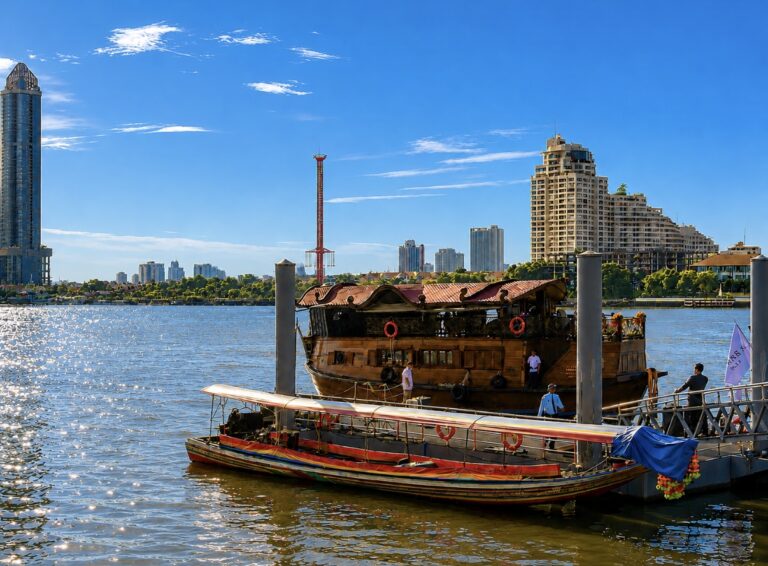
We recently embarked on a private voyage aboard the Loy Dream of Anantara Hotels and Loy Pela from Bangkok to Ayutthaya. Over four days, we sailed down the Chao Praya River from a pier in the city center towards the Gulf of Thailand before turning north for Bang Pa-In Palace and Thailand’s ancient capital on a restored century-old Thai rice barge.
Most travelers fly to Thailand for a beach holiday, a cultural excursion in Chiang Mai, or a food trip in Bangkok. We decided to make the trip across Asia to re-discover a very short stretch of Thailand in the most unusual way: by retracing the journey taken by the first foreign dignitaries to set foot in Thailand, sailing from the Gulf of Siam to Ayutthaya to pay respects to the King.
Taking the red-eye from Tokyo to Bangkok, we arrived early enough to beat Bangkok’s infamous traffic and drove directly to Anantara Riverside Bangkok Resort. Here, moored at riverside, the Loy Dream, a restored rice barge with two staterooms, making it the perfect private charter for families, was waiting for us.
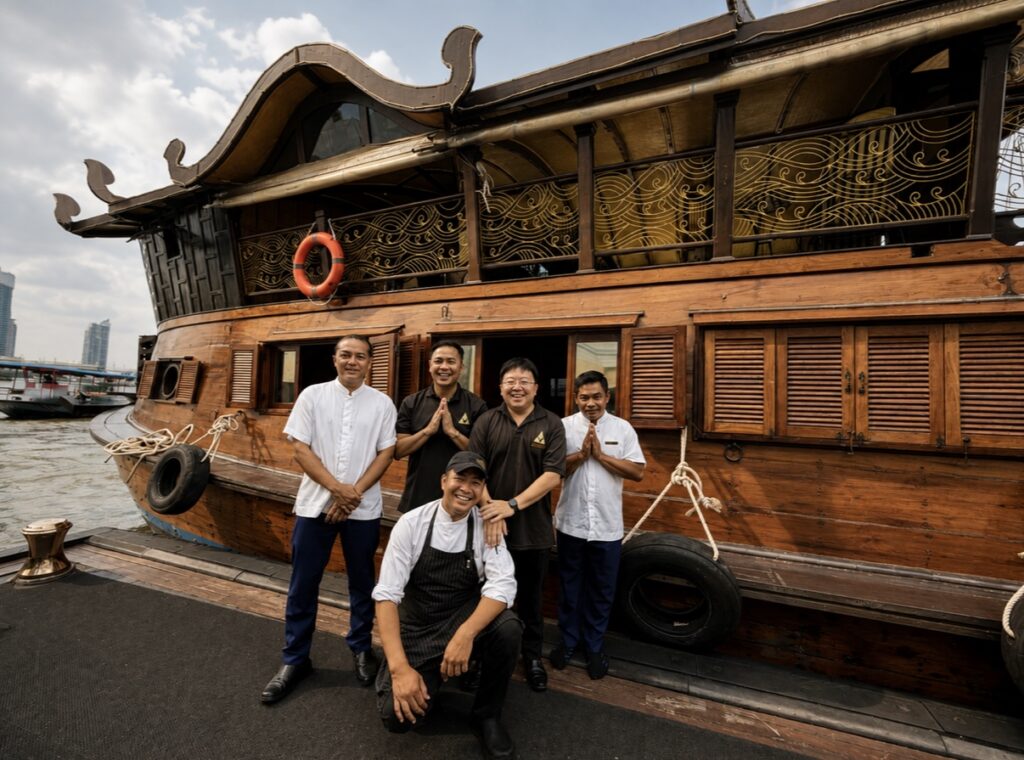
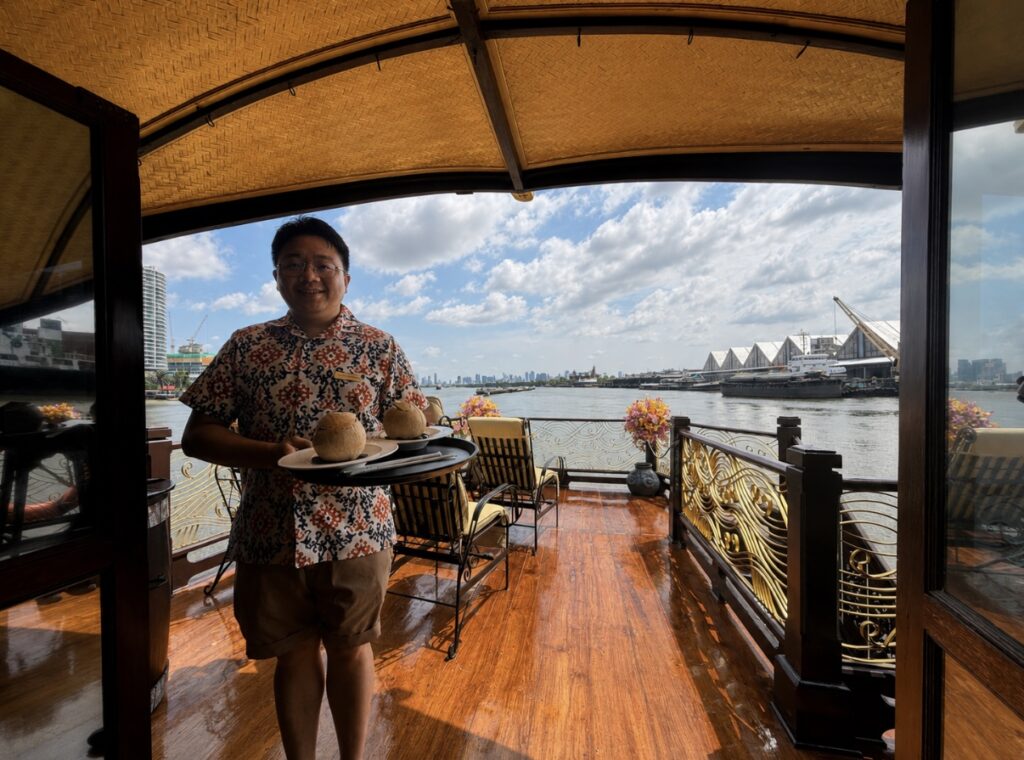
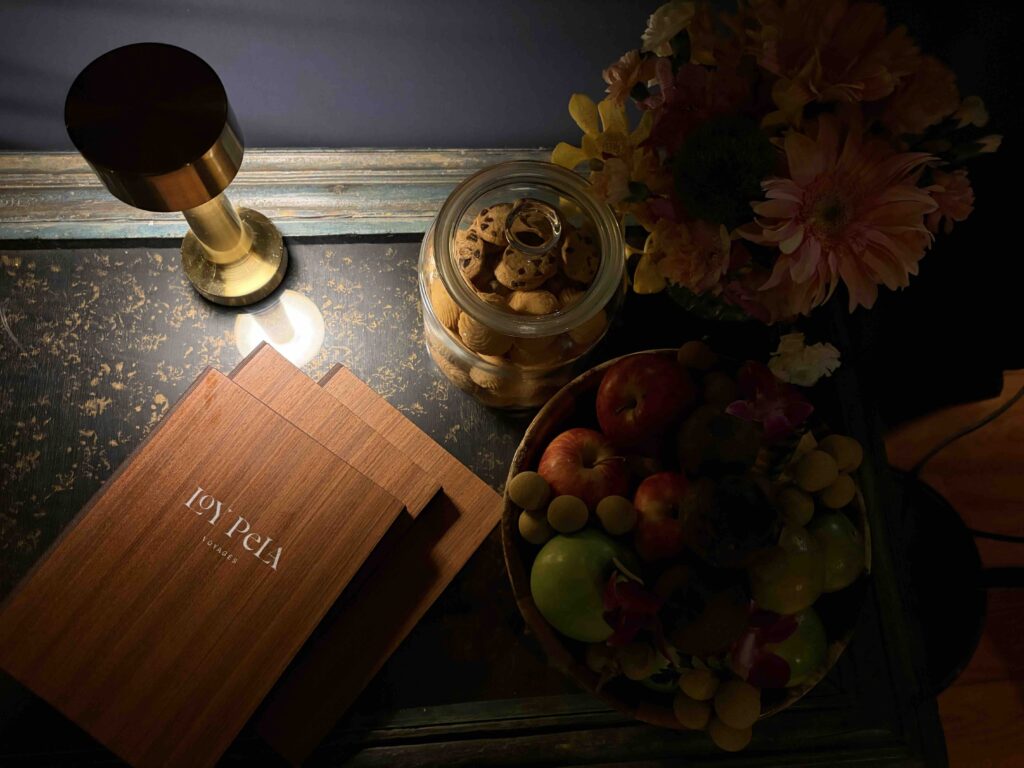
We were early for our 8 a.m. departure, so tropical fruit and fresh coconut juice appeared while we waited. Before long, two stewards, one dressed in the cruise uniform and the other in more formal Thai dress, approached us.
“Welcome to Bangkok,” one of them said. “We will be taking care of you for your cruise.”
They led us down to the river, where we saw Loy Dream for the first time. I’d seen photos of it when booking. However, meeting it in person for the first time gave it depth and life.
Meet the Loy Dream, a Century-Old Thai Rice Barge
I had wanted to charter a boat somewhere in Asia this summer, but I had been quite specific about what I did not want. Modern yachts, however luxurious, were out. There are plenty of them in Asia and the Mediterranean, and after a while — like many cruise ships in a certain category — they begin to look the same. It’s just the wallpaper and the color scheme that differs.
I wanted something that spoke to me specifically of Thailand.
The Loy Dream was exactly what I had hoped for. At 18 metres, she was long and low on the water. She still had the broad wooden hull of the rice barge she once was and a covered upper deck that looked almost as though a small Thai house had been placed on top. Round portholes punctuated the hull; dark timber, carved panels and ornate railings replaced the chrome and glass of a modern yacht.
Approximately a century old and restored for private luxury cruising, Loy Dream has just two staterooms and accommodates a maximum of four passengers. Against the high-rises of Bangkok, she looked wonderfully out of place. For the next four days, the entire boat belonged to us.
Within minutes of boarding, I knew I had made the right decision. In my mind at least, Bangkok had become Old Siam.
Inside Loy Dream
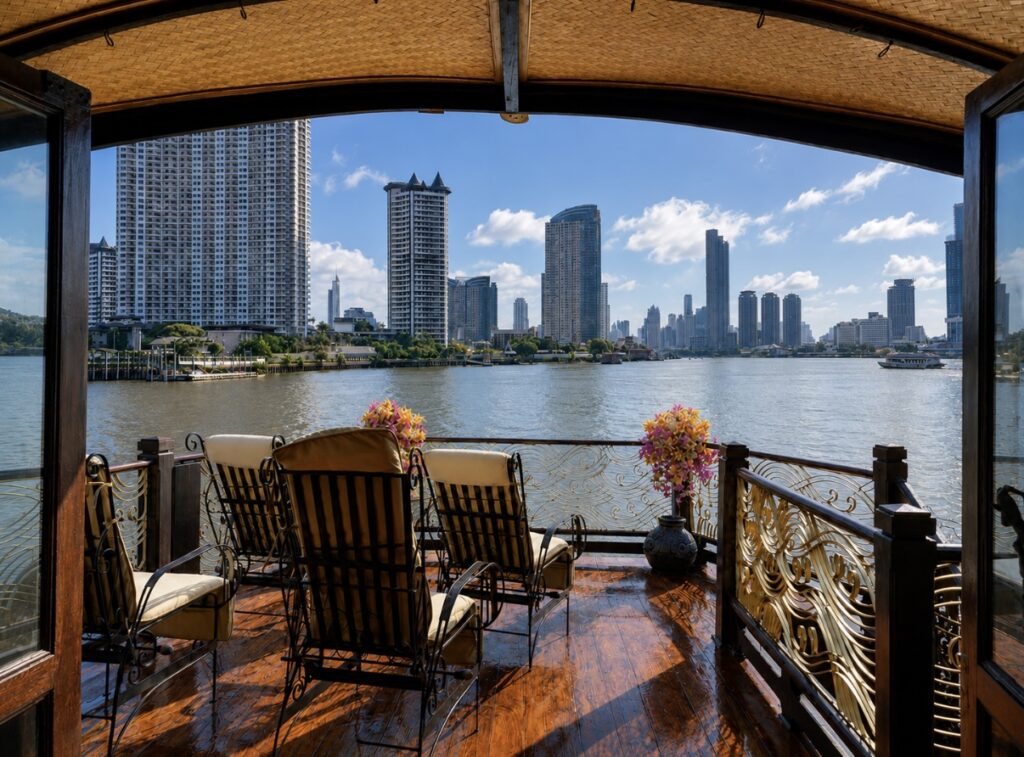
Within minutes of going onboard, I was already taking photos of everything. The main deck, with its traditional Thai accents, was so picturesque, and the observation deck was especially inviting.
I was about to sit down and relax when our steward invited me to further explore the boat.
“Perhaps you would like to see your stateroom first and prepare for the voyage?” our steward suggested. It was true. I was still wearing my sleeping travel wear from Tokyo, which was not quite vacation mode, and I needed to unpack to get the frenetic Tokyo vibe out of my system.
I followed him down a staircase and through a narrow hallway to a room at the end. This was to be my room, and I immediately liked it.
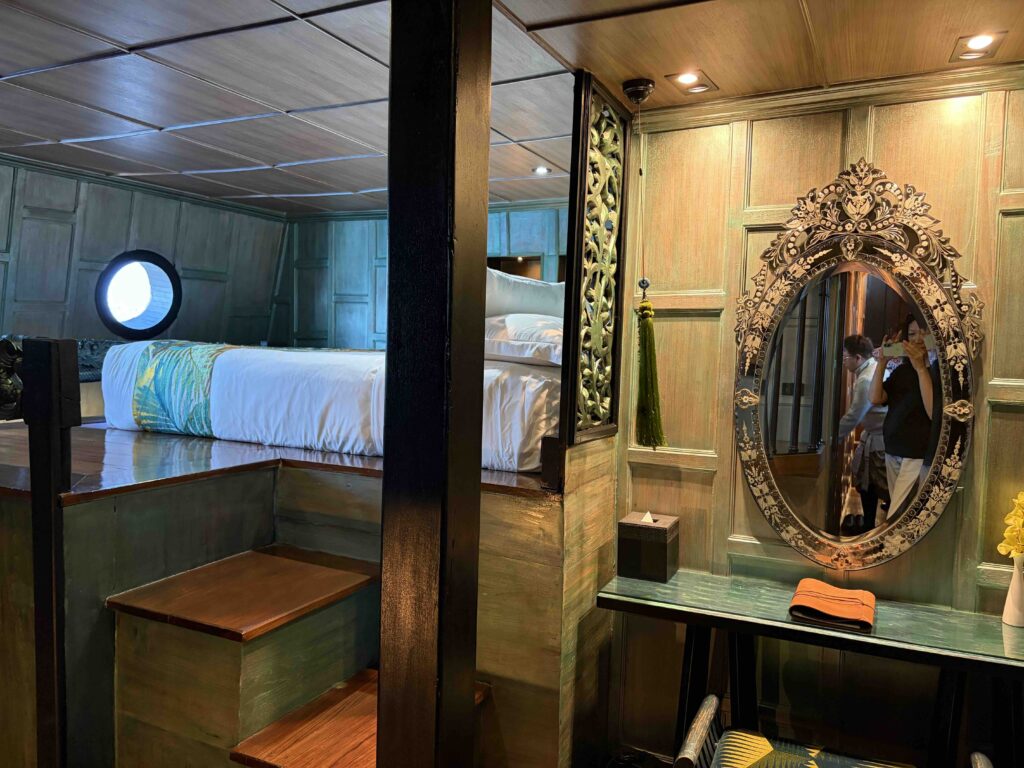
It was unconventional and slightly challenging considering the number of steps to navigate in one room. However, Anantara Hotels and Loy Pela had done what they could with the basic boat, since it had after all began life as a workhorse of a boat rather than a floating hotel.
The stateroom was deep rather than conventionally wide and arranged over several levels to fit the proportions of the original barge.
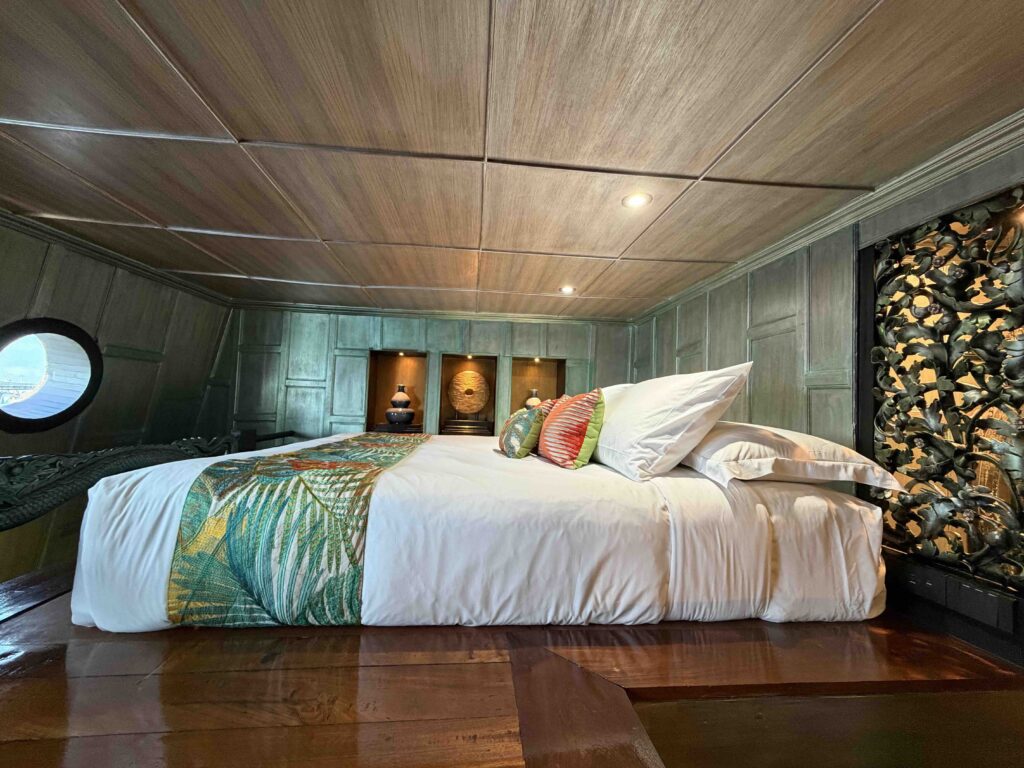
The walls were washed in pale celadon green, with polished timber underfoot, carved Thai screens, and a round porthole looking directly onto the river. Several steps above the entrance, the bed occupied its own raised wooden platform, almost like a room within the room, dressed in white linen and Thai textiles.
Down a few steps was a dressing area with an elaborate mirror. Beyond it came the surprise: a generously sized bathroom with a proper glass-enclosed shower and plenty of room to move around.
Loy Dream may have begun life carrying rice, but nobody was asking us to live like cargo. This is a luxury barge for travelers seeking a different way to travel. I had imagined spending hours on this raised bed with a book, watching the river through the porthole. In fact, I think I sat there exactly once.
Almost all our waking hours were spent upstairs because it was truly special.
Life Aboard Loy Dream
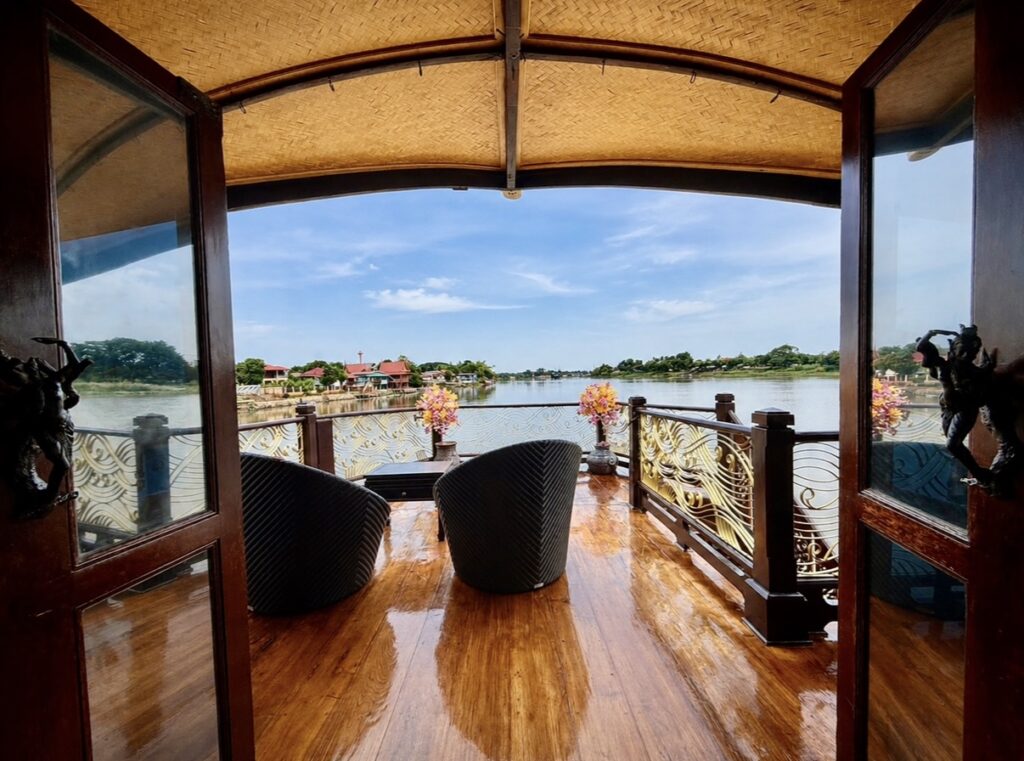
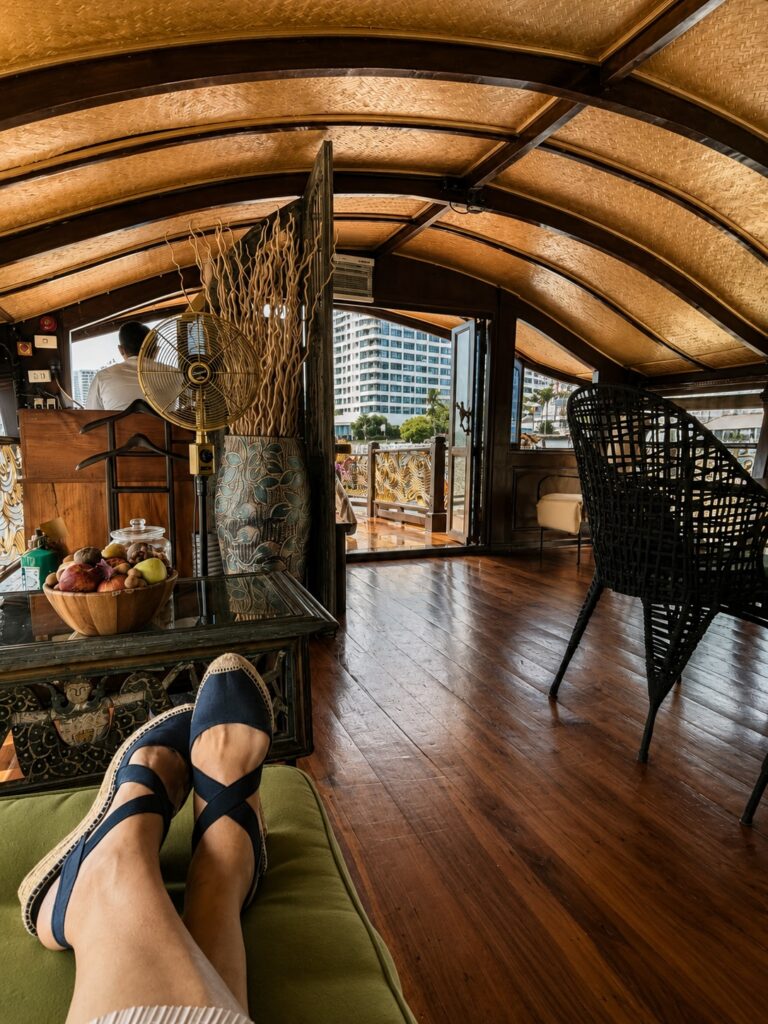
The covered upper deck ran almost the length of the boat, with polished floorboards, black woven chairs, Thai furniture, flowers, a dining table and broad openings on either side. At the bow, ornate railings framed the river ahead.
My favorite place was a green daybed piled with Thai silk cushions. From there, I could put my feet up and watch live alone the river. Perfect, especially with some fresh coconut juice.
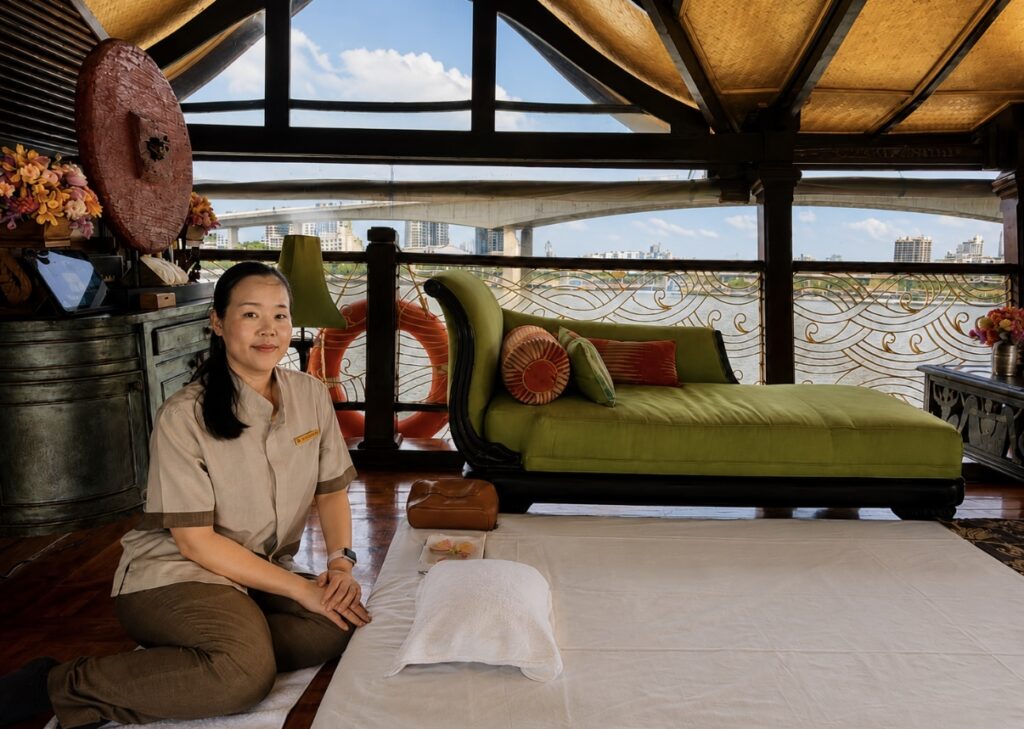
We had barely unpacked when the first activities began. The Anantara Hotels and Loy Pela Voyages do not just offer you a boat. When you book with them, you get an entire experience curated just for you.
My daughter had a yoga session, while a practitioner from Anantara’s spa turned part of the upper deck into a treatment room for my gua sha facial, using a jade scraper and roller. My husband had a traditional Thai massage nearby.
Meanwhile, Bangkok continued as usual outside.
Lunch on the Chao Phraya
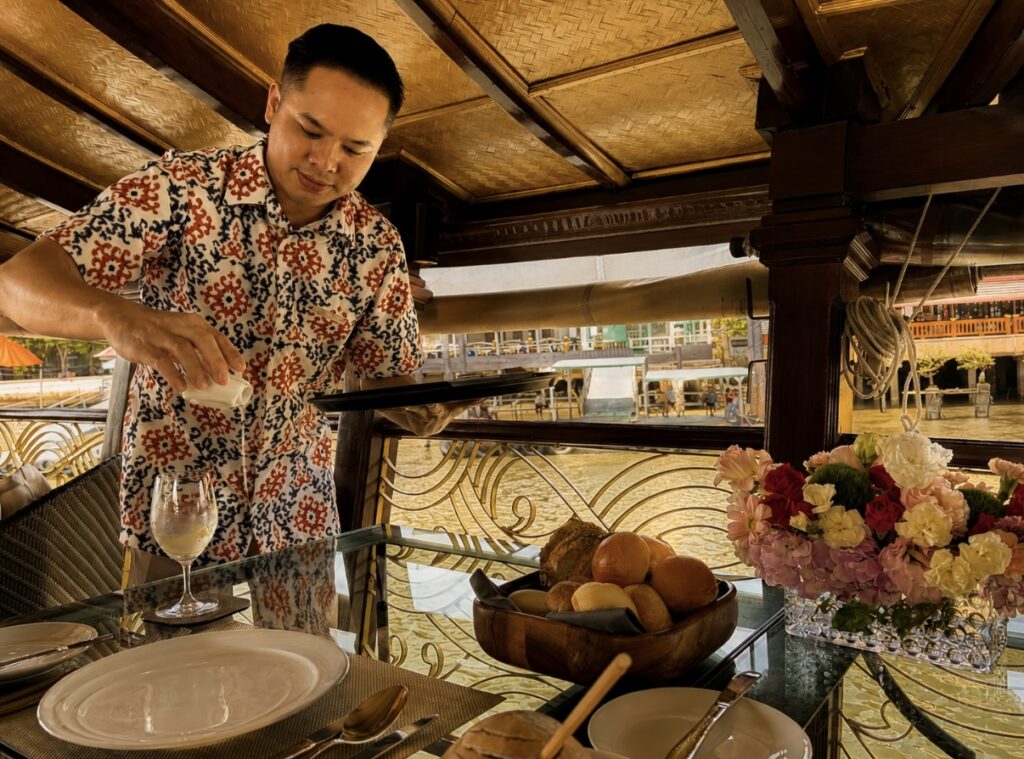
By noon, our private chef had made an appearance and discussed with us the extensive line-up of food he had in mind for our journey. Prior, I had sent over dietary preferences and requests (pad Thai!), which were duly noted.
“You wanted fresh coconut juice with every meal,” he said. “Just to let you know that we have thirty coconuts onboard.”
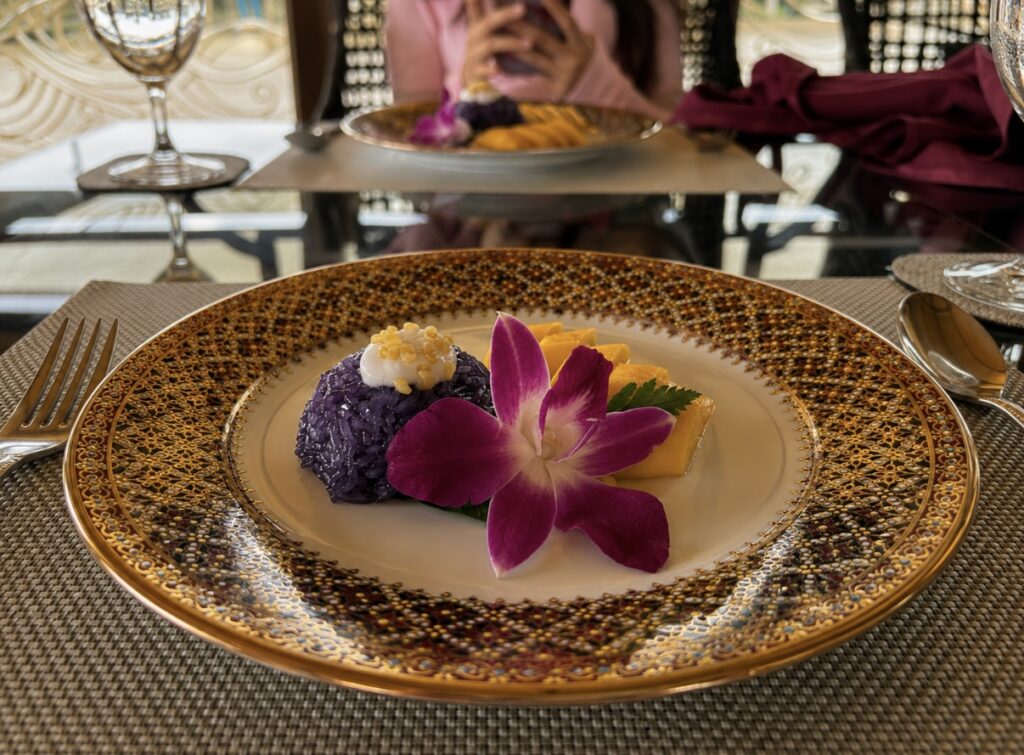
Meals aboard were generally served as multi-course menus rather than family-style spreads, and the table was set with the most beautiful Benjarong tableware.
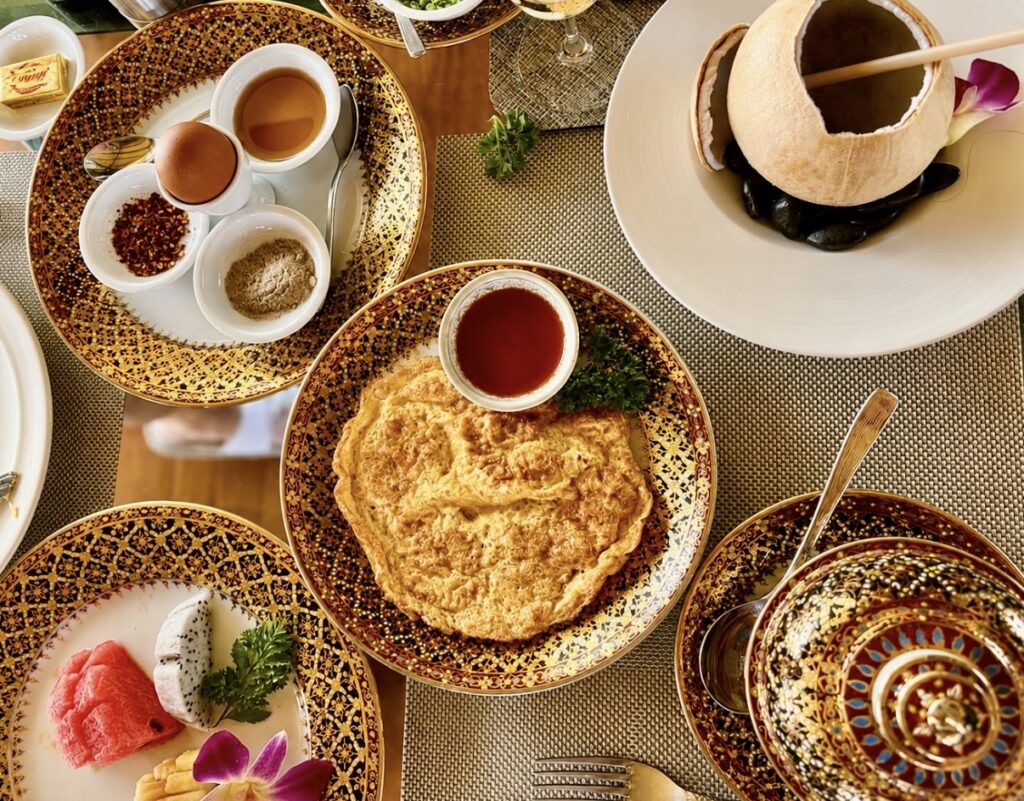
Having dined in the best restaurants in the world, there was nothing to fault — especially when one realizes the tiny kitchen the chef has to work with on an 18-meter boat, and the high standards guests expect the team onboard to uphold. This is not the world’s most expensive four-day cruise; but neither was it the cheapest in the luxury category.
Our first lunch began with a composed salad, followed by prawns and crisp pastry, and finished with ripe mango, purple sticky rice and coconut cream. The dishes were extremely good.
“This is much better than I expected,” I said to my husband, who had always been skeptical of any kind of cruise from the start. But this one one him over from the start.
From the River to Muay Thai
The voyage was to be four days of learning about the traditions and culture of Thailand in a most personal way. That afternoon we began our discovery with a destination hardly on the bucket list of most travelers to Bangkok: the great green expanse contained within a bend of the Chao Phraya and commonly known as Bangkok’s “green lung.”
Our guide was waiting with bicycles and tricycles. Our first stop was a Muay Thai school set among greenery and ponds, run by a former boxing champion who had retired from competition and was now teaching local children.
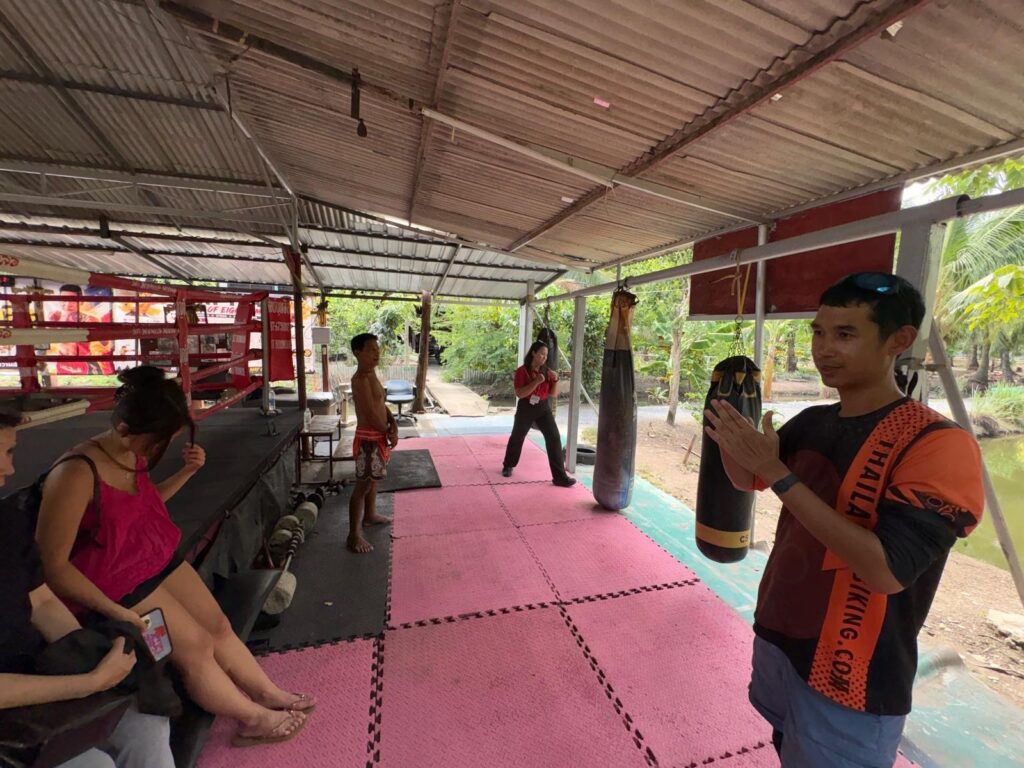
“Muay Thai is tough on the body,” he told us. “I spent my life hitting my body intentionally to make it tougher in every way. Even my bones are larger due to trauma.”
Today he passes on his same winning technique to school children who come to practice after school.
FROM THE CHAO PHRAYA TO GRANADA
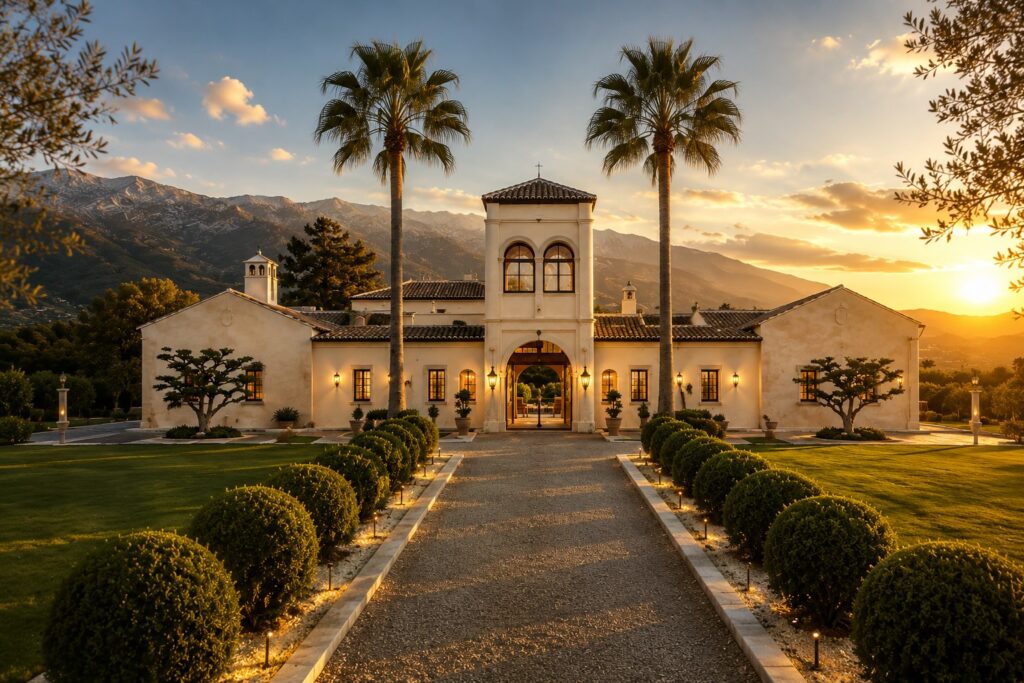
From a private teak barge on Thailand’s Chao Phraya to a one of the most romantic hacienda in southern Spain, some of the best journeys are about having an extraordinary place almost entirely to yourself.
Discover La Esperanza Granada — a private luxury villa near Granada for exclusive stays, weddings and celebrations in Andalusia.
Only a few hours earlier, I had been lying on the upper deck having my face worked over with a gua sha stone. Now I was standing beside a rice field watching children learn how to box.
We ended the excursion at a Hindu temple, where there were few foreign visitors and plenty of local worshippers going about their devotions. These were relatively simple stops, but that was part of their appeal. They offered glimpses of life beyond the Bangkok most visitors encounter.
After this visit, we returned to Loy Dream and continued south.
Cocktails on the Gulf of Siam
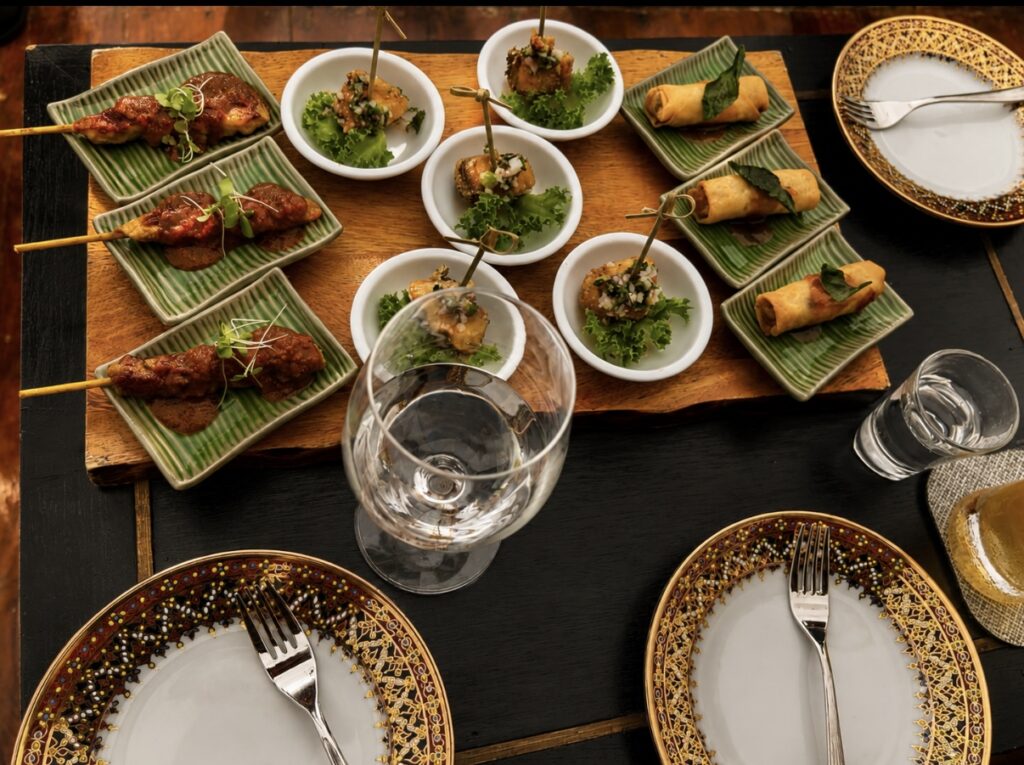
By early evening, cocktails appeared on the bow.
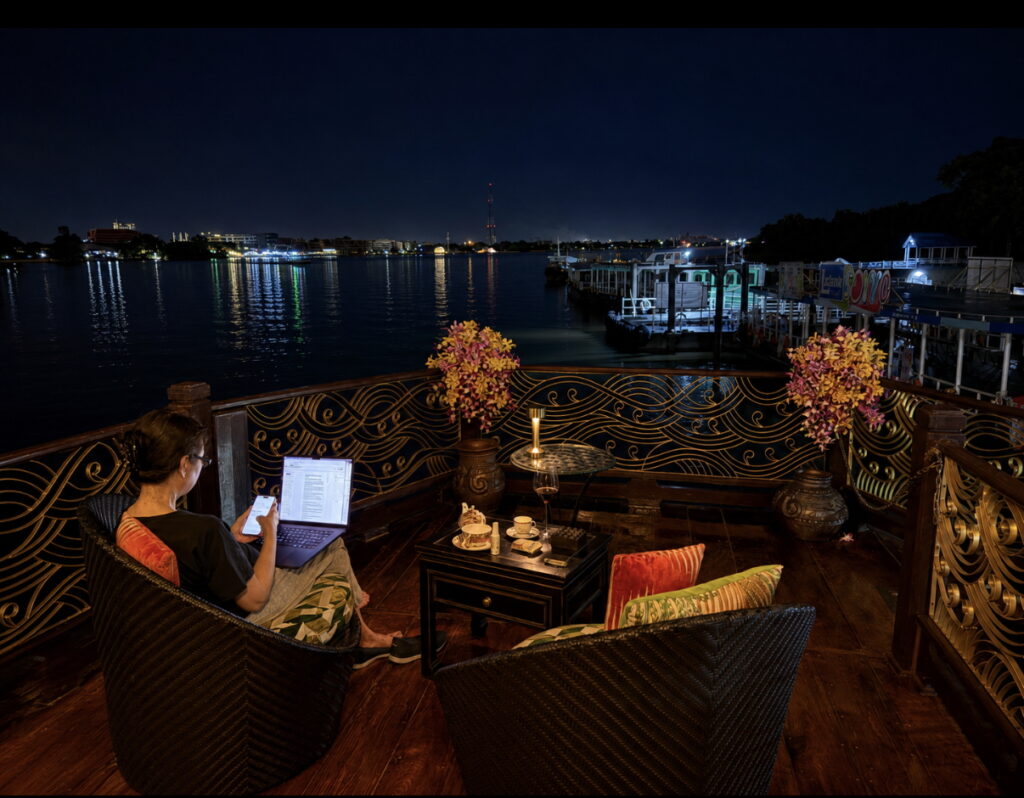
Flowers had been tied to Loy Dream’s ornate railings, and cocktails and a tray of Thai appetizers were set out as the light began to fade. Beyond our glasses were freighters, working ships and the lights of the industrial waterfront.
It was an unusual setting for welcome cocktails on a cruise in Thailand, and far more interesting than the conventional sunset panorama I had expected.
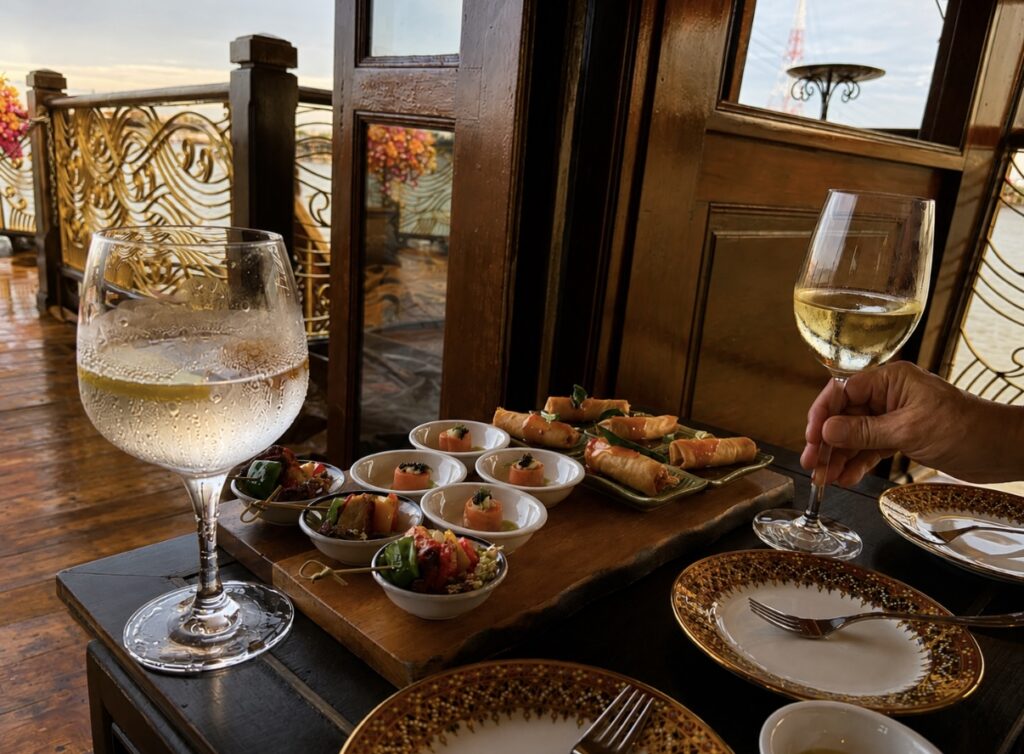
“Would you like another drink?” our steward asked. Of course we did. Every reasonable wish was possible on this boat.
Dinner for Three
Dinner was served beneath the curved wooden roof of the upper deck, where the table had been laid with flowers, wine glasses and exquisite Benjarong tableware.
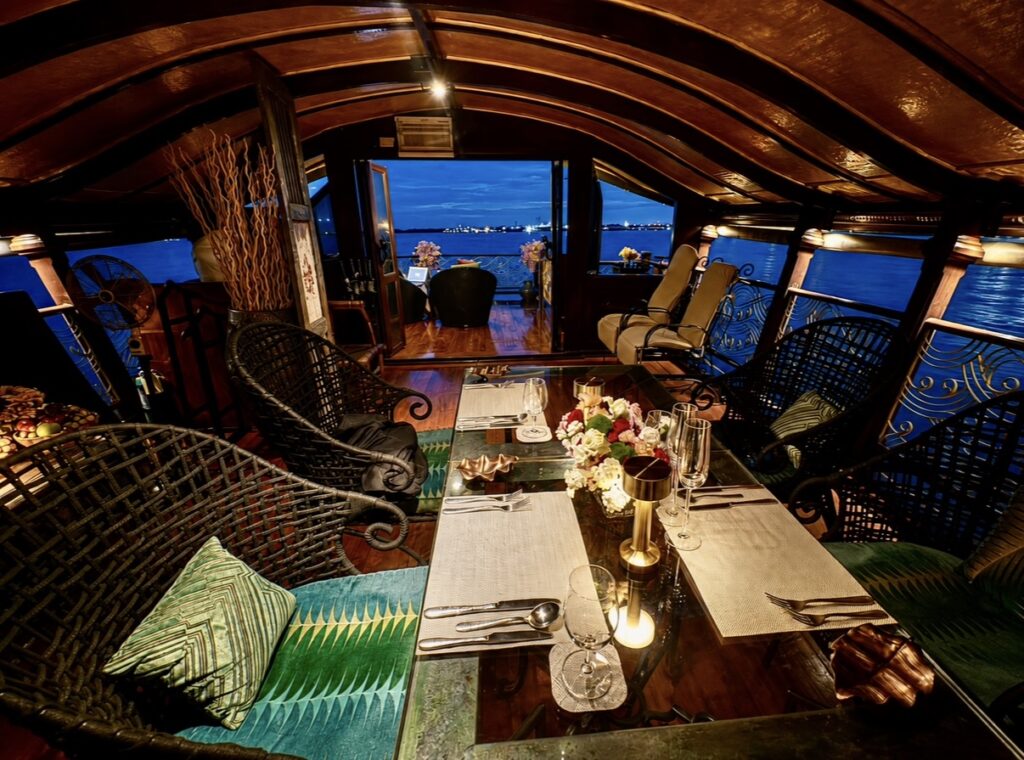
Our chef had planned the welcome dinner as a Thai interpretation of surf and turf. A procession of small appetizers was followed by an impressive lobster served on a plate with garnishing.
“I thought we were having a pomelo salad,” I remarked to the butler, scrutinizing that evening’s menu.
“That is our chef’s version of pomelo salad, Madame,” he replied, with a smile.
I looked more closely at my food. Indeed, the garnish next to the lobster was a ball of pomelo and pickles that were to be eaten with the lobster.
“This is the most decadent pomelo salad I’ve ever had,” I said. It was also among the most delicious too.
We ended our first day with drinks on deck overlooking the ships, docks and factories of the Gulf. It had been a remarkably full day—yoga, spa treatments, lunch, cycling, Muay Thai, a temple visit, cocktails and dinner—but it had never felt as though we were being marched through a programme.
From Bangkok to Ayutthaya by River
The following morning, Loy Dream turned around and began travelling north.
We passed through Bangkok again, watching the city assemble itself from the river: luxury hotels and residential towers, old palaces, Buddhist temples, working piers and riverside houses, with boats continually cutting between them.
Then Bangkok began to fall away.
The buildings became fewer and lower. The factories disappeared. Concrete gave way to vegetation, and traditional Thai river houses began appearing along the banks. Some were modest; others were substantial wooden homes that made us wonder who had once lived there—perhaps an aristocratic family or a prosperous merchant.
Eventually even the houses too became scarce.
Into the Greenery of the Chao Phraya
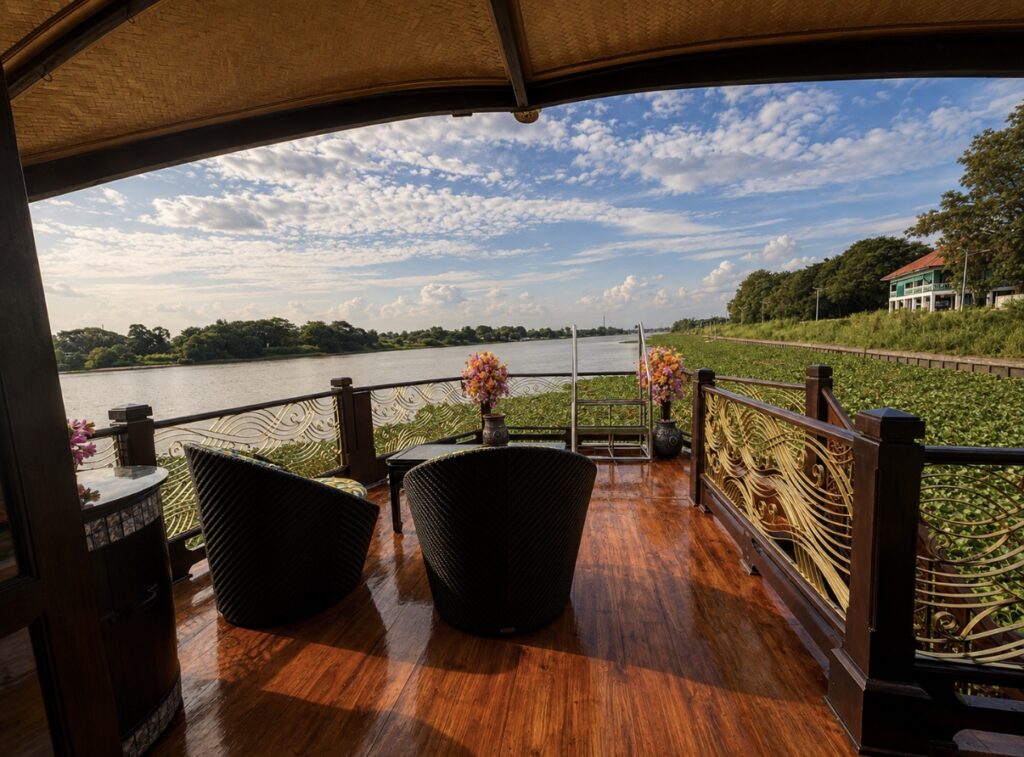
There were stretches of river where almost nothing appeared to be happening at all. Ahead was broad water; along the banks were dense vegetation and great patches of aquatic plants. Occasionally another boat appeared, or a temple, or a wooden house. Then there would be nothing again for quite a while.
This was where the bow came into its own. Two woven chairs faced forward on the polished wooden deck, with nothing between us and the view except Loy Dream’s ornate railing.
This part of the voyage was particularly enjoyable because there was nothing specific we were supposed to be looking at. We could read, listen to music, have a massage or simply sit at the bow and see what appeared around the next bend.
Sometimes nothing did, and that was perfectly fine.
Arriving in Ayutthaya by River
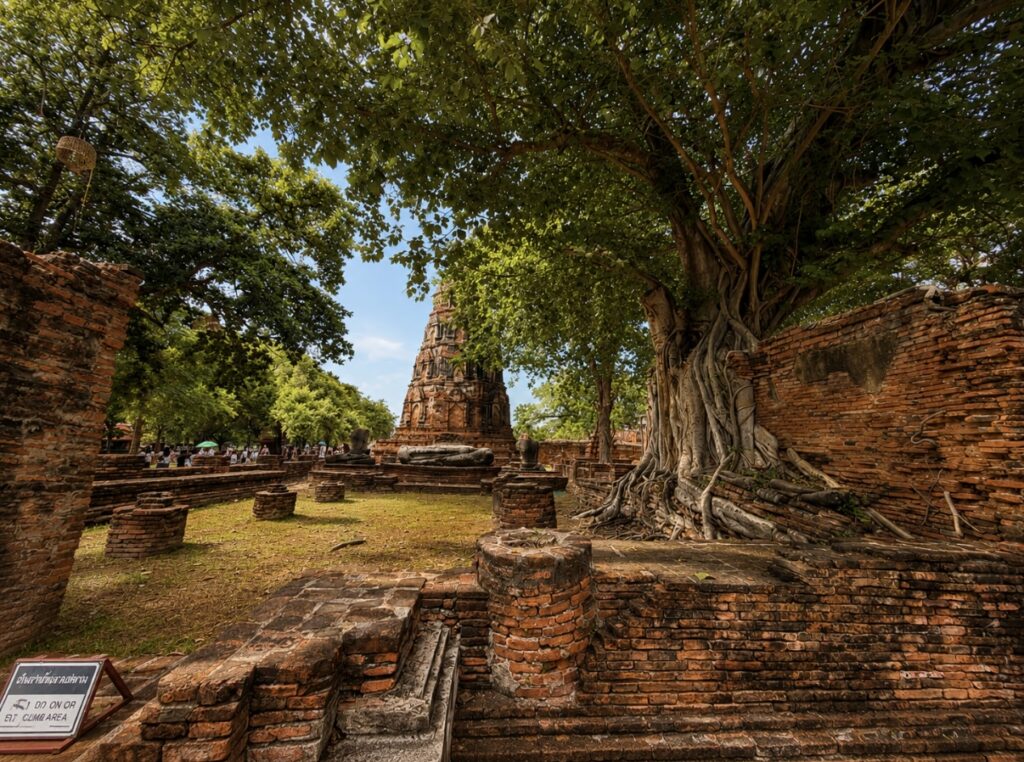
Founded in 1350, Ayutthaya served as the capital of Siam for more than four centuries, until its destruction by a Burmese army in 1767. At its height it was one of Asia’s great centres of commerce and diplomacy, with connections extending to China, Japan, India, Persia and Europe.
Its geography explains much of its success. Ayutthaya developed on an island surrounded by three rivers connected to the sea. Foreign merchants established communities there, while the Siamese court conducted diplomacy with governments thousands of miles away.
Arriving by river put that history into context. Instead of appearing as an isolated collection of ruins reached after a drive from Bangkok, Ayutthaya became the destination of the waterways that had helped create its wealth and importance.
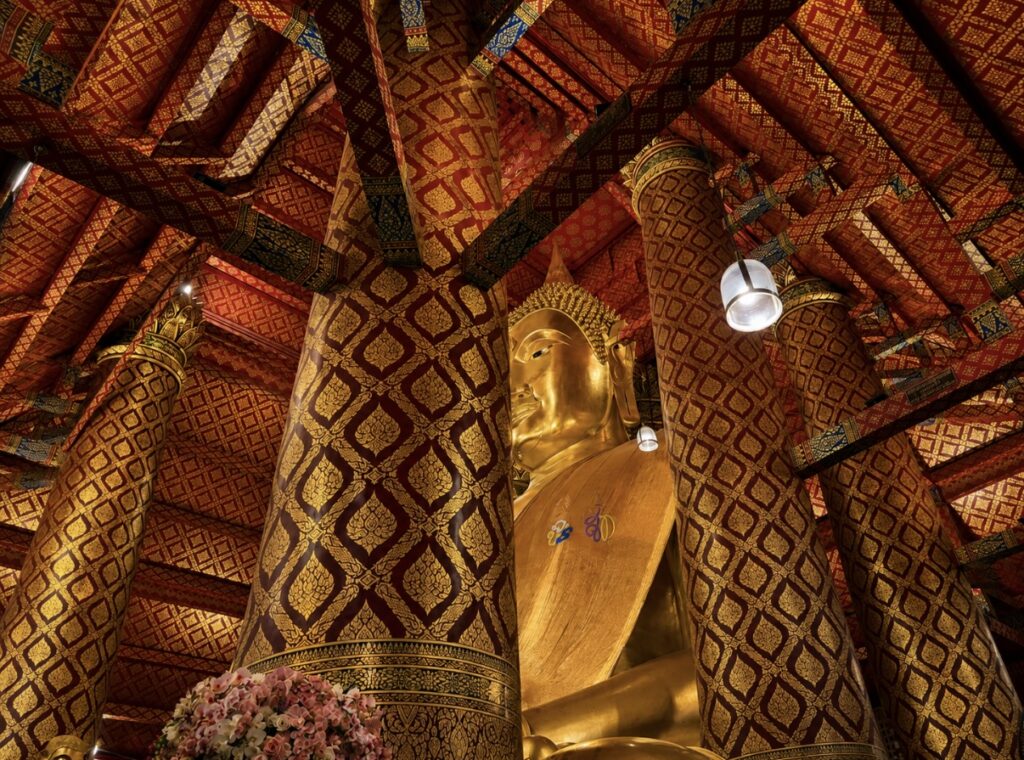
The boat charter included a private guide for the duration of the cruise, as well as local guides where needed. With our guide, we spent several hours exploring Ayutthaya Historical Park and other temples, walking among red-brick monasteries, weathered prangs, large Buddha images and enormous old trees that had grown around the remains.
Afterwards, it was back to the Loy Dream for a light lunch of salads and sandwiches.
At Your Service
The rest of our days followed a similar pattern, expertly arranged by Loy Pela and Anantara Hotels, but with enough flexibility to ensure that the itinerary never became an obligation.
We learned to make traditional Thai sweets from mung beans, visited temples and historical sites, and also enjoyed long periods for reading, listening to music or simply doing very little on deck.
At one point in Ayutthaya, after walking around in the heat, we decided to change our planned day..
“Can we have another Thai massage?” I asked.
A few telephone calls later, it was arranged.
The Famous River Prawns of Ayutthaya
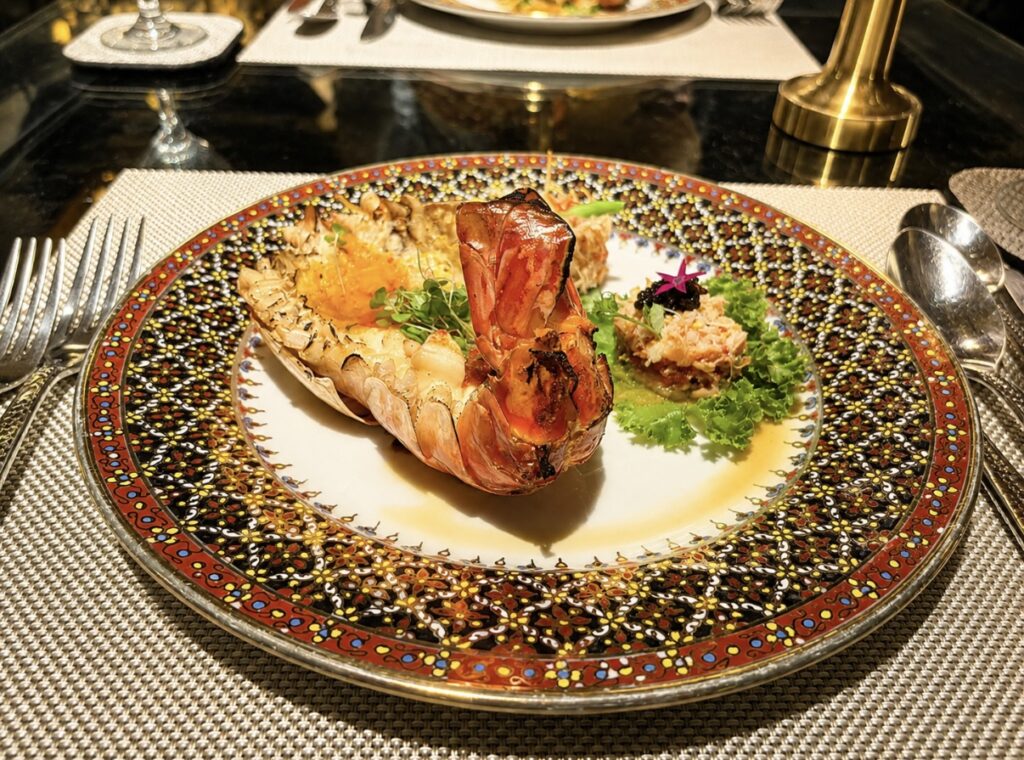
The chef outdid himself on this cruise, and every meal was wonderful. This was definitely not the usual catered food on a cruise. However, the highlight was the Ayutthaya river prawn, which is enormous and so tender when caught fresh.
We were fortunate enough to have these twice.
Our chef simply grilled them, leaving the flesh firm without becoming tough and allowing their natural sweetness to come through. The Thai seasoning he used paired perfectly.
One Last Temple
Before our first meal on our last day, we went ashore to a local temple to give thanks for our safe and happy journey. The crew had purchased baskets of food for each of us in advance to present as offerings.
We joined local worshippers, conspicuous as the foreigners in the group, presented our baskets and received a blessing from a monk, accompanied by a sprinkling of holy water from a ceremonial brush.
Then we returned to the boat for the chef’s version of a farewell brunch.
Caviar on a Century-Old Rice Barge
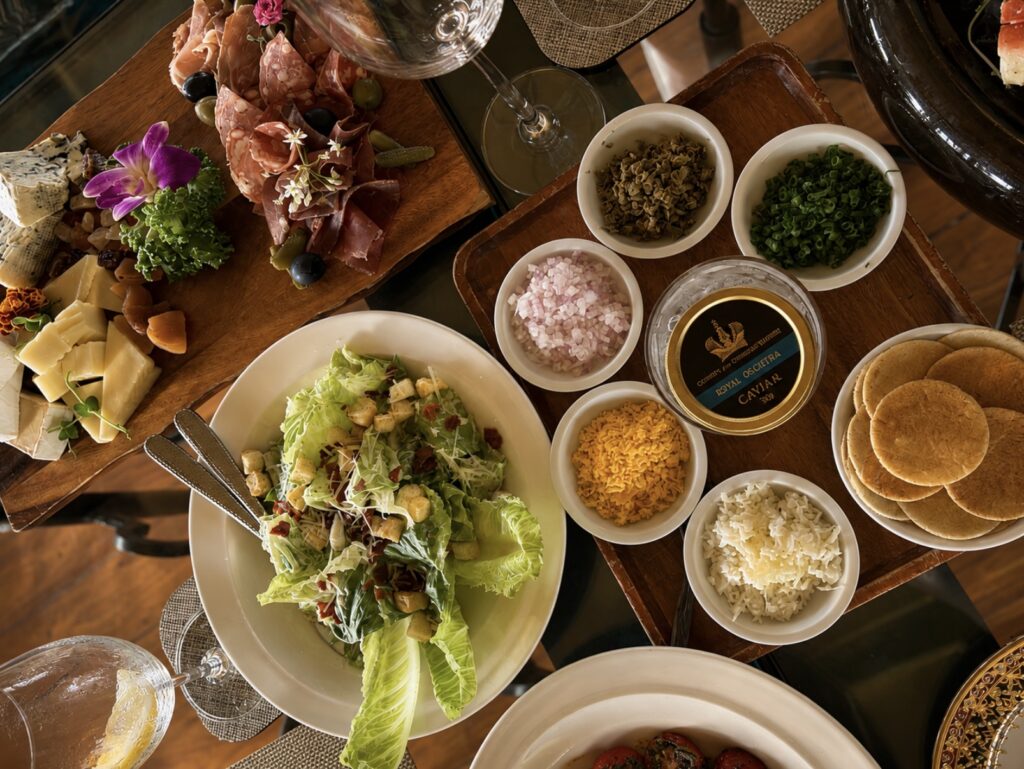
Calling it brunch hardly did it justice.
A large seafood platter occupied the centre of the table, piled with crab legs, prawns and mussels. Beside it sat a large tin of caviar with blinis and the usual accompaniments, along with salads and several other dishes that might reasonably have constituted lunch on their own.
Caviar had not been on my list of things I expected to eat aboard a converted Thai rice barge.
Halfway through the meal, our steward approached.
“Are you still hungry?”
“Not really,” I said. “But it will be a crime to say no to more of his delicious food.”
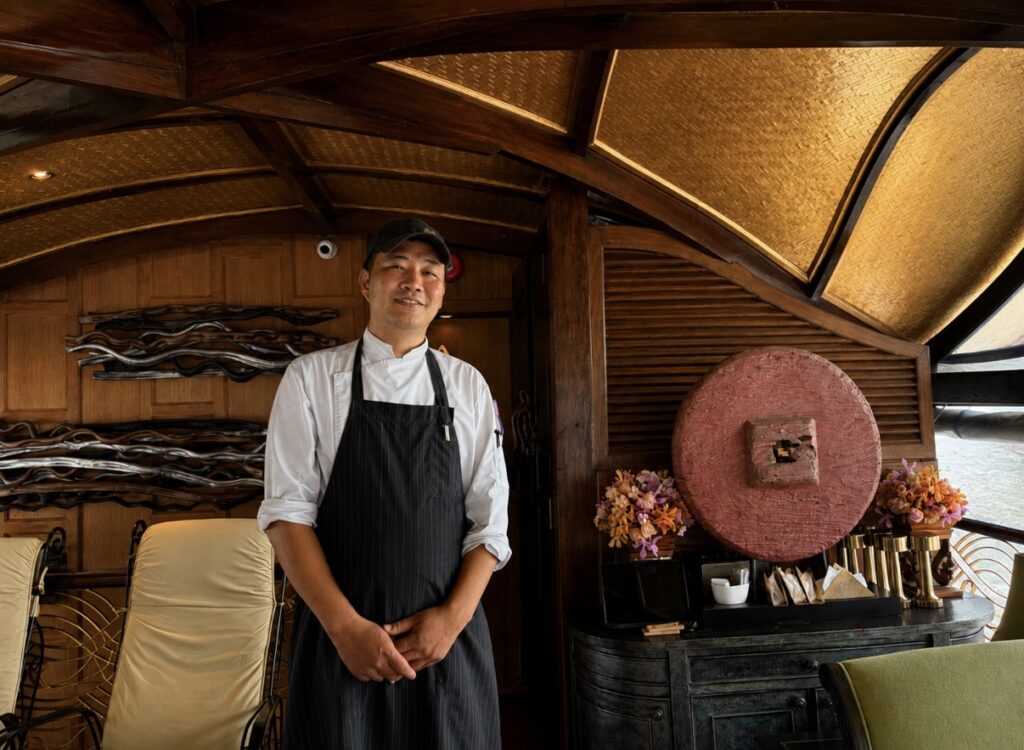
“Our chef would be delighted to prepare his specialties for you.”
Since this was our final meal aboard, refusing seemed unnecessarily sensible.
There were eggs Benedict and other Western breakfast dishes. I asked for Thai noodle soup and pad Thai.
Naturally, we ordered them.
Back to Bangkok
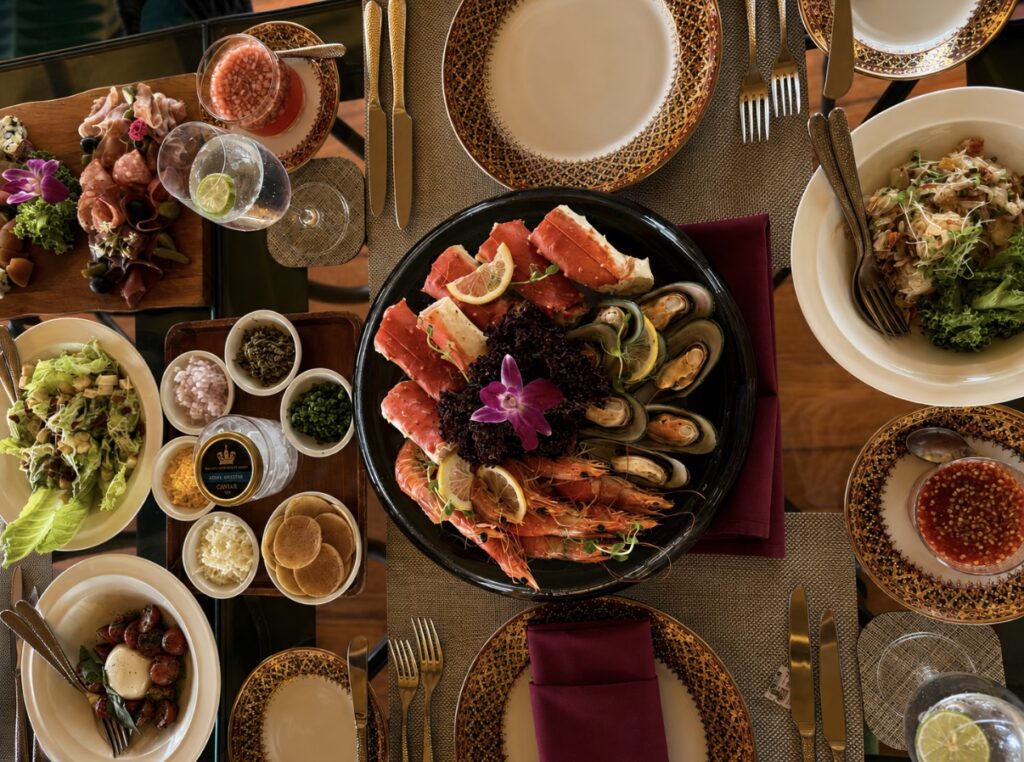
And so our final approach to Bangkok was made over an increasingly improbable brunch of seafood, caviar and blinis, followed by eggs Benedict, noodle soup and pad Thai.
It was far too much.
We ate it anyway.
Outside, Bangkok gradually returned. The banks became more densely built, and houses were followed by temples, hotels and high-rises.
Four days earlier, we had left the same city aboard an old wooden rice barge, travelling south through factories and freighters towards the Gulf of Siam. Then we had made a U-turn and travelled north through a completely different landscape of traditional river houses, vegetation, temples, royal palaces and the ruins of Ayutthaya.
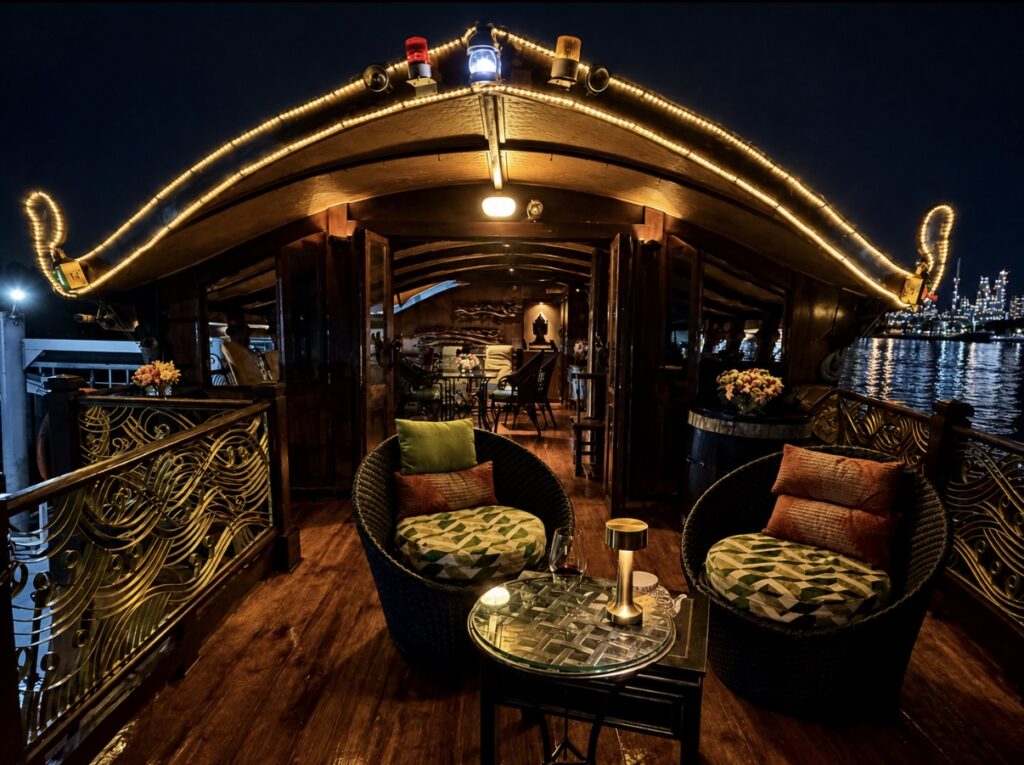
That, ultimately, was what made the voyage interesting. We had seen the Chao Phraya not simply as a backdrop to Bangkok but as a working river, a transportation route, a link to Thailand’s history and, for four days, the view from our own front deck.
Driving from Bangkok to Ayutthaya would have been considerably faster. Three hours to be exact. But this was precisely the point. We were not seeking to check attractions off a sightseeing list, but to experience a part of Thailand in the most unusual way.
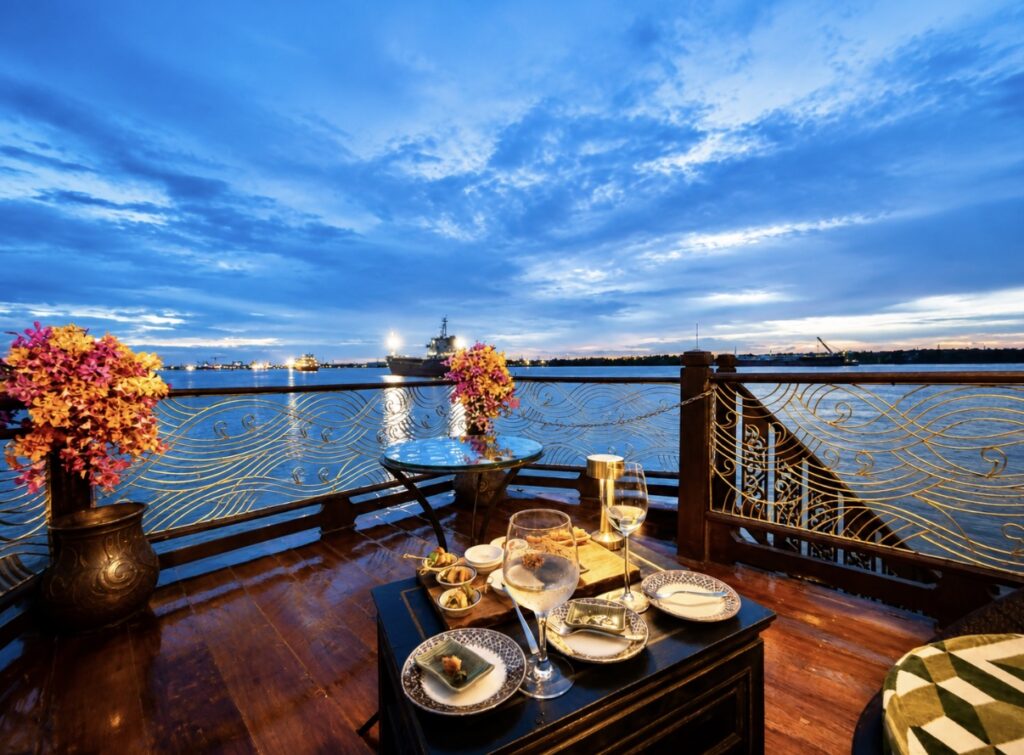
The Loy Dream antique rice barge had been on my bucket list and now I was happy to cross it off. For travelers seeking authenticity, this cruise falls into the same category as the Orient Express train journeys although it is not as seamlessly luxurious.
The price points are also different. Chartering this boat may not be cheap, but it is also not expensive for travelers seeking the unique.
My four days onboard were relaxing and happy. Although I did disembark the Loy Dream with one very specific problem: I had developed a taste for freshly caught Ayutthaya river prawns, and I was going home to Tokyo.
FACTS ABOUT VOYAGES WITH LOY PELA / ANANTARA
What is Loy Dream?
Loy Dream is an 18-metre restored Thai rice barge operated by Loy Pela Voyages by Anantara. The private vessel has two air-conditioned ensuite staterooms and accommodates up to four guests.
What is the itinerary?
Our four-day, three-night private voyage departed from Anantara Riverside Bangkok Resort and travelled south along the Chao Phraya towards the Gulf of Thailand, historically known as the Gulf of Siam. Loy Dream then turned north, travelling through Bangkok towards Bang Pa-In Palace and Ayutthaya before returning to the city.
What is life aboard like?
Most of the day is spent on the large covered upper deck, which contains the dining area, seating and daybeds, with open views of the river. The two split-level staterooms below have air-conditioning and ensuite bathrooms.
What about food?
A private chef prepares meals aboard. Our menus included multi-course Thai lunches and dinners, lobster, Ayutthaya river prawns and a final seafood-and-caviar brunch. Meals were served on Benjarong tableware.
What can you do along the way?
Excursions vary with the itinerary and can include temples, Bang Pa-In Palace, Ayutthaya Historical Park and local experiences. Our voyage also included yoga, spa treatments, Muay Thai, a Thai dessert-making lesson and additional massages arranged along the way.
How flexible is it?
Because Loy Dream is privately chartered, there is considerably more flexibility than on a conventional cruise. Activities can be adjusted and additional experiences arranged where possible.
Who is it best for?
Couples, families or two couples looking for a private alternative to a conventional river cruise or modern yacht charter, particularly travellers interested in Thai history, food and life along the Chao Phraya.
Information and reservations:
Loy Pela Voyages by Anantara. Current itineraries, prices, inclusions and availability should be confirmed directly at the time of booking.
READ MORE ABOUT THE BEST CRUISES IN THE WORLD IN TRAVELIFE MAGAZINE